OpenAI accelerates GPT-5.2 launch to challenge Google Gemini 3 in the AI race


OpenAI has moved quickly to push forward the release of GPT-5.2 after Google’s Gemini 3 set new standards in the AI field. Recent trends show a sharp rise in industry activity:
OpenAI-associated companies have increased by 74% in 2025.
Alphabet-exposed stocks have surged by 146% during the same period.
A closer look at the current climate reveals the urgency driving OpenAI’s decision:
Evidence Type | Details |
|---|---|
Competitive Pressure | Google's Gemini 3 has topped AI leaderboards, shifting market perceptions significantly. |
Performance Evaluation | Internal evaluations indicate GPT-5.2 performs ahead of Gemini 3, necessitating a quick response. |
Timing Importance | Enterprise customers are making AI model selection decisions that will impact market share for years. |
The OpenAI GPT-5.2 vs Google Gemini 3 rivalry now shapes the future of artificial intelligence.
Key Takeaways
OpenAI is launching GPT-5.2 on December 9, 2025, to compete directly with Google Gemini 3, which has already set new industry standards.
The focus for GPT-5.2 includes advanced reasoning and coding capabilities, aiming to address previous challenges and enhance performance.
OpenAI's internal 'code red' memo highlights the urgency to improve ChatGPT's speed, reliability, and customizability in response to competitive pressures.
Users can expect faster responses and greater options to customize their interactions with ChatGPT, making it more relevant to their needs.
The rivalry between OpenAI and Google is driving innovation, emphasizing the importance of user experience as a key differentiator in the AI market.
AI Competition Intensifies

Gemini 3’s Industry Impact
Google Gemini 3 has reshaped the AI landscape. Its release marked a turning point for enterprise adoption and industry standards. Many organizations now rely on advanced AI models to improve reliability and compliance. Companies such as Box, Rakuten, Shopify, and Thomson Reuters report measurable gains in productivity and accuracy. Box automates workflows and interprets complex documents for legal teams. Rakuten improves technical analysis and legal reasoning. Shopify enhances customer support automation. Thomson Reuters maintains quality while handling demanding tasks.
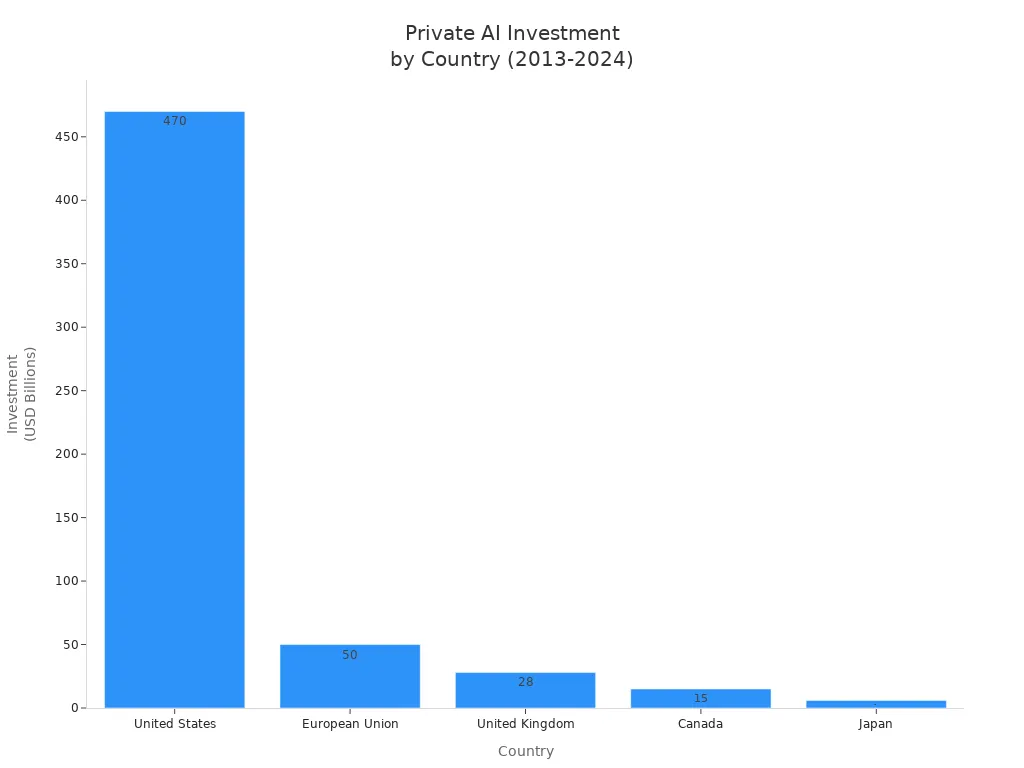
In 2025, over 82% of global enterprises increased AI adoption at both infrastructure and application layers. Gemini 3’s launch aligns with the demand for higher-accuracy, multimodal, and enterprise-secure models. The competitive landscape now features rapid innovation and rising investment. The United States leads with $470 billion in cumulative private AI investment since 2013.
Evidence Type | Description |
|---|---|
Regulatory Scrutiny | Regulators are investigating partnerships between large digital players and AI startups to assess their impact on competition. |
FTC Inquiry | In January 2024, the FTC launched a formal inquiry into major partnerships, requiring information from involved parties. |
EU Evaluation | The European Commission is evaluating whether Microsoft's cooperation with OpenAI is subject to merger control rules. |
CMA Investigation | The UK's CMA is considering a formal merger investigation regarding the Microsoft-OpenAI partnership. |
Access to Essential Inputs | Regulators are monitoring companies controlling essential AI inputs (data, computational resources, talent) to ensure fair competition for new entrants. |
Concerns Over Market Power | There are worries that mergers and acquisitions could entrench market power, particularly in the cloud service sector, which is under significant antitrust scrutiny. |
Open-source Models | While promoting innovation, regulators are concerned that open-source models may not foster competition against closed models, potentially leading to customer lock-in. |
OpenAI’s ‘Code Red’ Response
OpenAI responded to Gemini 3’s success with urgency. CEO Sam Altman declared a 'code red' and shifted resources to improve ChatGPT. The company postponed other initiatives, such as AI agents for shopping and healthcare, to focus on core product enhancements. Altman emphasized the need for ChatGPT to answer more questions and deliver higher quality. The internal memo highlighted the importance of personalization, response speed, and reliability.
We know we have some work to do, but we are catching up fast.
We are at a critical time for ChatGPT.
OpenAI reportedly lost 6% of its users in a week after Gemini 3’s launch. The Wall Street Journal described Altman’s memo as urgent, reflecting the pressure to surpass Google’s advancements. The OpenAI GPT-5.2 vs Google Gemini 3 rivalry now drives strategic decisions and resource allocation. Developers face challenges such as biased datasets, legacy system incompatibility, and a shortage of skilled AI talent. Executives view explainability as a major obstacle to adoption. Both companies must balance innovation with responsible use, transparency, and fairness.
OpenAI GPT-5.2 vs Google Gemini 3
Release Timeline and Readiness
The OpenAI GPT-5.2 vs Google Gemini 3 rivalry has reached a critical stage. Google Gemini 3 is already available and has made a strong impression in the market. OpenAI plans to launch GPT-5.2 next week, with the official release date set for December 9, 2025. This fast-tracked schedule shows OpenAI’s determination to respond quickly to Gemini 3’s advancements.
Model | Release Date | Readiness Level |
|---|---|---|
GPT-5.2 | Next week | Upcoming |
Google Gemini 3 | Already released | Available |
OpenAI accelerated development after Gemini 3’s launch. The company shifted resources to improve speed and reliability. This strategy aims to regain momentum and meet enterprise demands. Gemini 3 has already demonstrated its readiness by supporting billions of queries in Google Search. Its deployment proves its ability to handle large-scale tasks and enterprise applications.
Reasoning and Performance Comparison
OpenAI GPT-5.2 vs Google Gemini 3 presents a direct comparison of technical capabilities. Gemini 3 stands out for its advanced context understanding, decision making, and continuous adaptation. It features versatile multimodal toolchains and supports wider cross-platform execution. The model maintains conversation continuity and orchestrates autonomous workflows. These features make Gemini 3 a leader in enterprise-scale AI solutions.
Feature | Description |
|---|---|
Context Understanding | Enhanced ability to process context in conversations. |
Decision Making | Improved decision-making based on user input and context. |
Continuous Adaptation | Learns and adapts from interactions. |
Multimodal Toolchains | Handles various types of data and tasks. |
Gemini 3 Pro leads benchmarks for multimodal work. It excels in coding, automation, and enterprise workflows. Businesses use Gemini 3 for customer support automation, internal AI copilots, and data analysis. Its 1M context window gives it an edge over previous models, allowing it to manage large-scale tasks efficiently.
OpenAI GPT-5.2 vs Google Gemini 3 also highlights anticipated strengths of GPT-5.2. Internal evaluations show that GPT-5.2 focuses on advanced reasoning and coding capabilities. The model aims to address past challenges faced by OpenAI, especially in reasoning tasks. Preliminary tests suggest strong performance and significant advancements over previous models. GPT-5.2 improves pretraining efficiency and incorporates bug fixes and enhancements.
Anticipated Improvements | Details |
|---|---|
Advanced Reasoning | Enhanced reasoning capabilities, addressing previous challenges. |
Coding Capabilities | Improved coding functionalities for developers. |
Performance in Tests | Strong results in preliminary evaluations. |
Pretraining Efficiency | Optimized architecture without increasing model size. |
Bug Fixes and Enhancements | Multiple improvements for better overall performance. |
OpenAI GPT-5.2 vs Google Gemini 3 continues to shape the future of AI. Both models compete for leadership in reasoning, reliability, and scalability. Gemini 3 sets new standards for enterprise applications, while GPT-5.2 aims to surpass these benchmarks with its upcoming release.
User Impact and Future Trends
ChatGPT’s New Focus
OpenAI has shifted its strategy for ChatGPT. The company now prioritizes speed, reliability, and customizability. Users want faster responses and more stable performance. OpenAI’s internal memo highlights the urgency to improve quality. The team focuses on core functionalities instead of adding new features.
OpenAI is prioritizing improvements in speed and reliability for ChatGPT.
The focus is on enhancing core functionalities rather than introducing new features.
The internal 'code red' memo indicates urgency in improving the quality of ChatGPT.
Customizability has become a key area. OpenAI introduced custom instructions, allowing users to tailor ChatGPT’s responses. This feature started with Plus plan users and will soon reach everyone. Users can now adjust the tone and depth of responses, making ChatGPT more relevant and precise for different needs.
What Users Can Expect
Users will notice several changes in the next version. The table below outlines the most anticipated improvements in GPT-5.2:
Anticipated Changes | Description |
|---|---|
Speed | Improvements in response time and processing speed |
Reliability | Enhanced stability and consistency in performance |
Customizability | Greater options for users to tailor their experience |
Feedback from early users of Gemini 3 shows how these changes impact real-world use:
I am working with four different agents right now, one is working and another needs my help to proceed. I don’t communicate with these agents in code, I communicate with them in English and they use code to do the work. Because Gemini 3 is good at planning, it is capable of figuring out what to do, and also when to ask my approval. Importantly, I felt that I was in control of the choices AI was making because the AI checked in and its work was visible. It felt much more like managing a teammate than prompting an AI through a chat interface.
Evolving AI Language Models
The OpenAI GPT-5.2 vs Google Gemini 3 rivalry signals a new era for AI language models. Recent advancements include voice assistants with near-real-time interaction and AI systems that can control computers. Automation and agentic AI will make user interactions smoother. Industry-specific solutions will become more common. Multimodal capabilities, such as processing text, images, and video, are expanding. Ethical frameworks are also gaining attention to address privacy and bias.
Automation and Agentic AI are expected to enhance user interaction with AI systems.
A shift towards industry-specific AI solutions tailored for enterprise needs.
Continued advancements in multimodal capabilities, allowing for diverse data processing.
These trends show that AI models will become more helpful, adaptable, and responsible in the future.
OpenAI’s rapid launch of GPT-5.2 signals a strategic response to Google’s Gemini 3 and highlights the urgency in the AI race.
Evidence | Description |
|---|---|
Accelerated Release | OpenAI is launching GPT-5.2 sooner than expected, indicating a strategic response to competition. |
Innovation Commitment | OpenAI’s rapid release cycle signals to developers a commitment to continuous innovation and adaptation. |
Industry experts predict that competition will drive innovation and shape future market strategies. User experience will become a key differentiator as technical performance among AI models begins to plateau. Companies must focus on clarity, trust, and usability to maintain leadership in the evolving AI ecosystem.
FAQ
What is the main difference between GPT-5.2 and Gemini 3?
GPT-5.2 focuses on advanced reasoning and coding. Gemini 3 excels in multimodal tasks and enterprise workflows. Both models offer strong performance, but each targets different strengths in AI capabilities.
When will OpenAI release GPT-5.2?
OpenAI plans to launch GPT-5.2 on December 9, 2025. The date may change based on final testing and readiness. Users should watch official channels for updates.
How will users benefit from GPT-5.2’s improvements?
Users will experience faster responses, better reliability, and more options to customize ChatGPT. These upgrades help users complete tasks more efficiently and tailor AI interactions to their needs.
Why did OpenAI accelerate the GPT-5.2 launch?
OpenAI accelerated GPT-5.2’s release to respond to Google Gemini 3’s advancements. The company aims to maintain its leadership in AI by delivering improved performance and meeting enterprise demands.
Will GPT-5.2 support multimodal features like Gemini 3?
GPT-5.2 will include enhanced reasoning and coding. Multimodal features may expand in future updates. Gemini 3 currently leads in processing text, images, and other data types.
See Also
Enhance Your AI's Intelligence Quickly With GPT-5 Optimizer
Google's Antigravity AI Revolutionizes Coding With New Tools
Vercel Introduces Innovative AI Element for Developers
Jule The AI Assistant Simplifies Software Development Processes

© Copyright 2025 LinkstartAI - All Rights Reserved.