The Ultimate AI Sales Stack


The ultimate AI sales stack gives you a powerful edge in today’s competitive market. You can streamline your process, boost productivity, and make smarter decisions. Over 61% of sales teams already use AI-powered tools, and 71% believe these tools will improve sales performance.
With the right stack, you tackle common challenges such as data quality, real-time syncing, and the need for personalization.
Challenge | Explanation |
|---|---|
Data Quality and Integration Issues | Poor data quality leads to bad decisions, affecting targeting and engagement strategies. |
Need for Human Oversight | Human review ensures relevance and adaptability in automated messaging, enhancing personalization. |
Personalization in Sales Outreach | Genuine connections and relationship building require human interaction, which AI cannot replicate. |
Key Takeaways
An AI sales stack combines smart tools to streamline your sales process, boost productivity, and enhance decision-making.
Using AI tools can lead to significant improvements, such as a 30% increase in productivity and a 50% higher conversion rate.
Automation of repetitive tasks allows sales teams to focus on building relationships and closing deals, resulting in shorter sales cycles.
Integrating AI tools with existing systems ensures smooth workflows and accurate data, maximizing the value of your sales stack.
Choosing the right tools based on your team's needs and goals is crucial for achieving better sales results and efficiency.
AI Sales Stack Overview

What It Is
You can think of an ai sales stack as a group of smart tools that help you sell better and faster. These tools use ai to handle tasks that used to take a lot of time. You get more time to talk to customers and close deals. The stack often includes:
Data enrichment tools like Clay that give you more details about your leads.
Communication assistants such as ChatGPT that help you write emails or messages.
Meeting analysis tools like Fathom that record and summarize your calls.
Skill development tools such as Hyperbound that help you learn new sales techniques.
CRM platforms like HubSpot to keep track of your contacts and deals.
Sales engagement tools like Outreach to help you reach out to leads.
Analytics platforms like HockeyStack to measure your results.
Conversation intelligence tools like Fireflies to analyze your calls.
Intent data tools like Bombora to find out who is interested in your product.
Personalized video outreach tools like HeyGen to make your messages stand out.
These tools work together to give you a complete view of your customers and help you make better choices.
Why It Matters
You need an ai sales stack because it changes how you work. Traditional sales tools make you spend a lot of time on paperwork and searching for information. With ai, you can automate these tasks and focus on selling. You get faster research, better data, and more time with customers. By 2027, almost all seller research will start with ai, up from less than 20% in 2024. Teams using ai see a 15% jump in response rates compared to old methods.
Companies using ai-powered platforms like Salesforce’s Einstein Analytics report higher productivity and better sales forecasts.
You also avoid data silos because ai tools bring all your information together. This makes it easier to see what works and what needs to change. Only 7% of teams reach high forecast accuracy with old tools, but ai makes this much better.
Here are some real results companies have seen after using an ai sales stack:
Benefit Description | Percentage Improvement/Reduction |
|---|---|
Average productivity increase reported by companies | 30% |
Reduction in operational costs reported by companies | 20-30% |
Higher conversion rates using AI for lead prioritization | 50% |
Cost reductions in customer acquisition | 40-60% |
More deals closed with conversation intelligence | 22% |
Faster ramp time for new hires | 33% |
Increase in meetings booked by Outreach.io | 32% |
Reduction in sales cycle length by Outreach.io | 25% |
Improvement in sales productivity by Outreach.io | 44% |
Reduction in time spent on prospecting by ZoomInfo | 60% |
Increase in pipeline generation by ZoomInfo | 35% |
Improvement in overall sales efficiency by ZoomInfo | 28% |
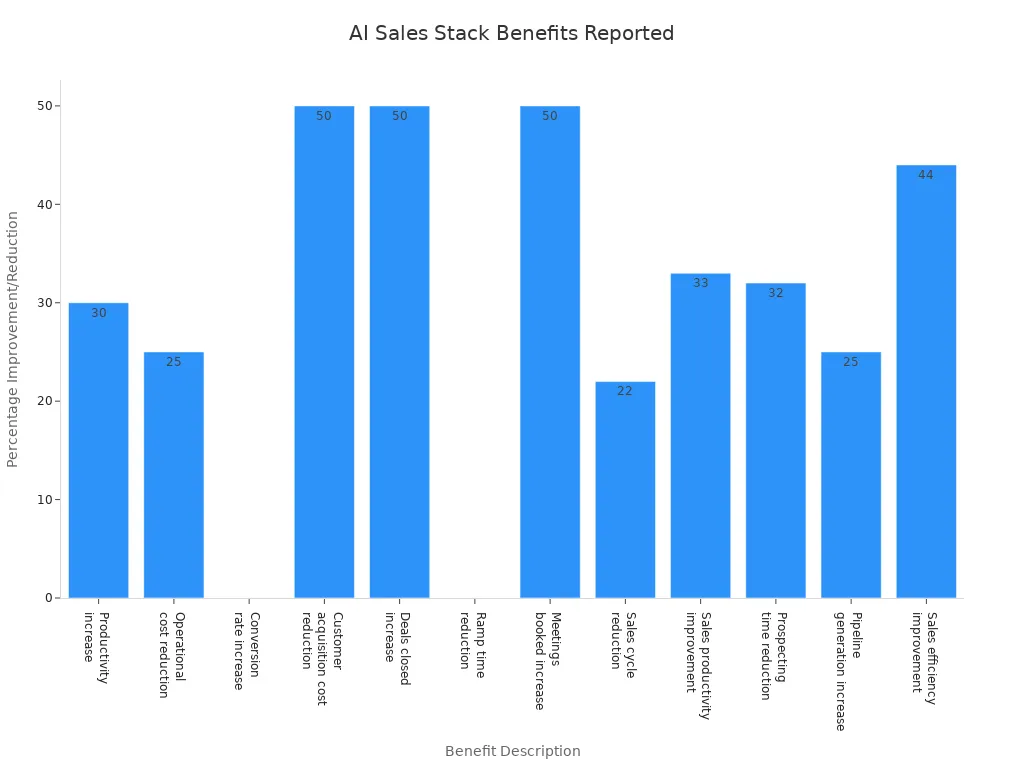
You can see that using ai in your sales process leads to real gains in productivity, cost savings, and deal success.
AI in Sales

Transformation
You have seen big changes in sales because of ai. These tools help you work faster and smarter. You can use ai to do research on leads, find patterns in data, and get real-time advice. Many companies now use ai to handle tasks that used to take hours. For example, companies like Kixie and SPOTIO use ai to automate calls and give you instant feedback. This means you spend less time on busywork and more time talking to customers.
Here are some ways ai has transformed the sales process:
The global sales intelligence market will grow from $3.65 billion in 2025 to $9.02 billion in five years.
75% of B2B buyers want personalized interactions, and ai helps you deliver that.
You can also see these changes in your daily work:
Ai can improve win rates by 30% or more.
80% of retail leaders expect to use ai automation by the end of 2025.
74% of sales reps believe ai will shape their jobs in the future.
When you use ai, you get better research, faster answers, and more time to build real relationships.
Impact
Ai has a strong impact on your sales results. You can close deals faster and win more often. Teams that use ai see shorter deal cycles and bigger deals. You can use ai to track every step of the sales process and spot problems early. This helps you make better choices and reach your goals.
Metric | Percentage |
|---|---|
Shorter deal cycles | 78% |
Higher win rates | 76% |
Increase in deal size | 70% |
Reported shorter deal cycles | 81% |
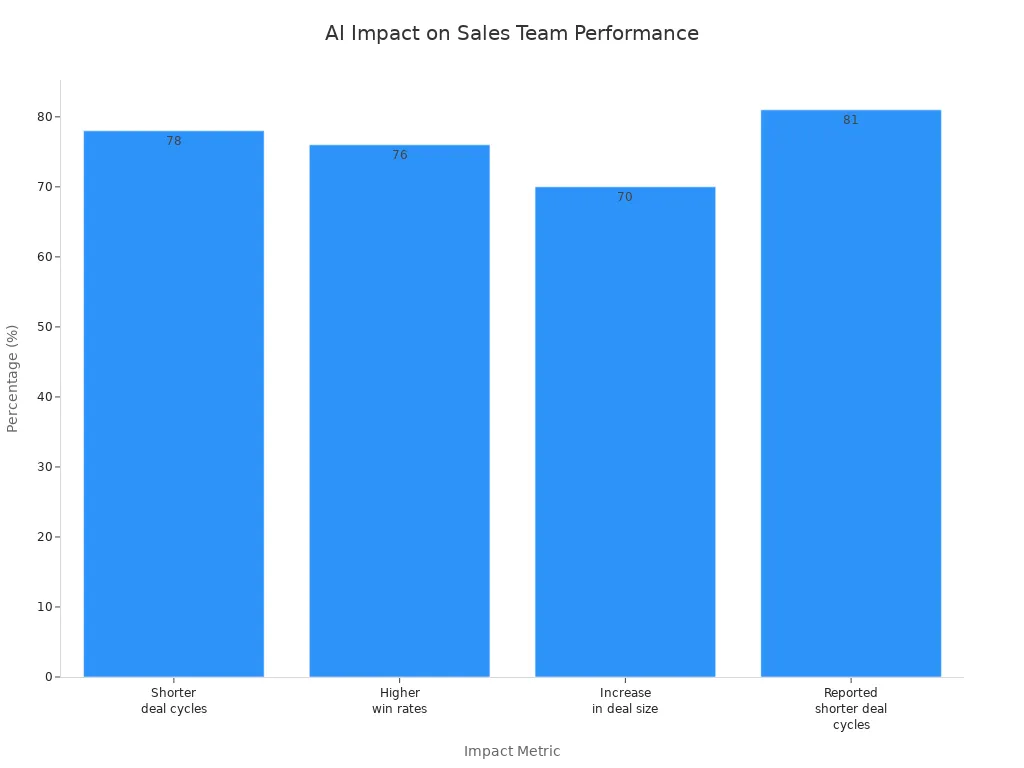
You can see that ai makes a real difference. When you use ai for research and sales, you get better results and more success.
Stack Categories
A strong ai sales stack covers every step of your sales process. You use different ai sales tools for each stage, making your team more efficient and effective. Here are the main categories you need to know:
Lead Generation
You start with lead generation. AI tools help you find and qualify leads faster than manual sales prospecting. These tools score and prioritize leads, send cold email follow-ups, and even schedule meetings. You get a 28% increase in qualified leads and a 15% boost in sales productivity when you use ai for this stage. Data enrichment and deep account research make your targeting sharper. This means you spend less time searching and more time selling.
Engagement
Next, you focus on engagement. Sales engagement tools use ai-driven personalization to connect with prospects at the right time. You can send hyper-personalized outreach and cold email campaigns that stand out. Predictive analytics and natural language processing help you understand customer conversations and improve conversion rates. Thoughtful personalization leads to more replies and better relationships.
CRM
CRM is the heart of your stack. AI-powered crm intelligence gives you a clear view of every customer. Automated crm updates keep your data fresh and accurate. You can track every touchpoint, from account-based marketing to buyer enablement tools. With ai, you get better insights into customer behavior and can run personalized campaigns that drive results.
Sales Enablement
Sales enablement tools help your team prepare for every call and meeting. AI automates research, creates content, and suggests next steps. You can use buyer enablement tools to deliver the right information at the right time. Teams using ai for enablement see higher revenue and faster deal cycles. Effective uses of ai free up your time for high-value work.
Analytics
Analytics ties everything together. AI analyzes your pipeline, tracks conversion rates, and spots trends. You get real-time feedback on what works and what needs to change. This helps you make smarter decisions and reach your goals faster.
Each category in your ai sales stack supports a key part of the sales process. When you combine them, you build a system that helps your sales team win more deals with less effort.
Top Tools
Cognism
Cognism helps you find the right leads quickly. You use it to build accurate lists for sales prospecting. The platform gives you real-time company intelligence and verified contact data. You can trust the information because Cognism checks it for accuracy. The tool also automates data enrichment, so your lead lists stay fresh. You spot buying signals and reach out at the best time. Cognism follows global data rules, so you work with confidence. You connect Cognism to your crm, making your workflow smooth.
Key Features:
Real-time company intelligence
Verified contact data
Automated data enrichment
Buying signal monitoring
Compliance with data regulations
CRM integration
You use Cognism to speed up research and improve conversion rates. It fits perfectly into your ai sales stack by making lead generation smarter and more reliable.
Drift
Drift lets you talk to website visitors in real time. You use ai chatbots to answer questions and qualify leads 24/7. The bots ask smart questions and gather details, so your sales team knows who is ready to buy. Drift also books meetings and shares product info automatically. You deliver personalized messages based on past chats, which boosts engagement. Drift connects with your crm, so you see every customer interaction in one place.
Drift’s AI Features:
Intelligent lead qualification
Automated meeting booking
Personalized experiences
Reduced support load
Seamless crm integration
Drift’s chatbots increase customer engagement by 40% compared to old chat tools. You never miss a lead, even after hours. Drift stands out among sales engagement tools for its real-time, ai-powered conversations.
Ada
Ada automates your customer conversations. You use it to handle billions of brand interactions every year. Ada’s platform turns website visitors into revenue by answering questions and guiding them through the sales process. It helps your marketing, sales, and support teams work together. Ada makes sure you never miss a chance to connect with new or existing customers.
Use Cases:
Automate sales conversations
Convert visitors into leads
Support collaboration across teams
Ada fits into your stack by making sure every customer gets fast, helpful answers. You save time and boost your sales results.
Salesforce
Salesforce is a leading crm that uses ai to help you manage your pipeline. You get predictive lead scoring, so you know which leads to focus on. Salesforce Einstein gives you insights about your opportunities and suggests the next best actions. The platform automates tasks, so your team can spend more time selling. You track performance in real time with ai-powered dashboards.
AI-Powered Features:
Predictive lead scoring
Opportunity insights
Automated task assignments
Next best action recommendations
Real-time performance monitoring
You use Salesforce to keep your data organized and your sales process efficient. It supports your ai sales stack by giving you the tools to make smart decisions and close more deals.
Attio
Attio is a modern crm built for teams that need flexibility. You use Attio’s ai-native features to adapt quickly to changes in your industry. The platform lets you design custom workflows without any coding. You track team performance and assign tasks easily. Attio works well for smaller teams that want to move fast and collaborate.
Unique Benefits:
AI-native design
No-code/low-code customization
Team collaboration tools
Customizable data structures and pipelines
Attio helps you organize your sales process and keep everyone on the same page. It fits into your stack by making crm management simple and powerful.
Gong
Gong records and analyzes your sales calls. You use it to capture data from Zoom, Teams, or Google Meet. Gong’s ai goes beyond just writing down what was said. It finds risks, flags follow-ups, and spots customer objections. You see who talked the most and how long you discussed key topics. Gong builds a searchable library of every call, so you can review and learn anytime.
How Gong Supports You:
Analyzes conversations for risks and follow-ups
Detects objections and talk ratios
Provides actionable insights
Creates a searchable call library
Gong helps your sales team improve with every call. You use it to coach reps, spot trends, and boost conversion rates.
Explee
Explee lets you create engaging sales presentations with ai. You use it to make animated videos and slides that grab attention. The platform improves your content quality and helps you personalize presentations for each audience. Explee automates design and gives you real-time feedback during practice. You save time and stand out from competitors.
Benefit | Description |
|---|---|
AI makes your presentations more compelling. | |
Improved Engagement | Personalized, animated content keeps your audience interested. |
Streamlined Creation | Automation saves you time on design and data analysis. |
Data-Driven Insights | AI tailors presentations to your audience using customer data. |
Real-Time Feedback | Practice with instant feedback to improve delivery. |
Competitive Advantage | Stay ahead by adapting quickly to market changes. |
Explee fits into your ai sales stack by making your sales enablement materials more effective and memorable.
HubSpot
HubSpot is a popular crm that helps you manage contacts, deals, and tasks. You use its ai tools to automate follow-ups and personalize outreach. HubSpot tracks every interaction, so you always know where each lead stands. The platform gives you analytics to measure what works and what needs improvement. You can connect HubSpot with other tools in your stack for a seamless workflow.
Key Features:
Automated follow-ups
Personalized outreach
Contact and deal tracking
Analytics and reporting
Integration with other ai sales tools
HubSpot supports your sales team by keeping your pipeline organized and your outreach effective.
Outreach
Outreach is a leader in sales engagement tools. You use its ai features to predict which deals will close and get recommendations on what to do next. Outreach summarizes account activities and provides insights into buyer sentiment. The platform generates personalized email responses and highlights action items from calls. Outreach also helps you manage your pipeline and forecast revenue with high accuracy.
Feature | Description |
|---|---|
Smart Deal Assist | Predicts deal closure and recommends actions. |
Smart Account Assist | Summarizes account activities and answers key questions. |
Topics and Reactions | Gives insights into buyer sentiment from meetings and emails. |
Smart Email Assist | Generates personalized email responses. |
Smart Meeting/Call Assist | Summarizes meetings and provides AI responses. |
Automated Speech Recognition | Transcribes calls in real time. |
Live AI Action Item Detection | Highlights action items from calls. |
Pipeline Management | Analyzes pipeline coverage and trends. |
AI Sales Forecasting | Predicts revenue outcomes with high accuracy. |
You use Outreach to boost engagement, improve cold email campaigns, and keep your sales process on track.
Clay
Clay streamlines your sales research and prospecting. You use it to automate data sourcing, lead scoring, and outreach personalization. Clay tracks job changes and company updates, so you reach out at the right time. The platform’s ai agent, Claygent, finds the information you need fast. You set your own rules for lead scoring and create custom workflows for data enrichment. Clay generates cold email intros based on LinkedIn bios and job titles, making your outreach more effective.
Clay’s AI Features:
Automated data sourcing and enrichment
Real-time intent data tracking
AI-powered lead scoring
Custom workflow creation
Automated cold email generation and follow-ups
Clay helps your sales team save time and increase efficiency. You use it to manage prospecting efforts and keep your pipeline full.
You can see how each of these ai sales tools fits into your ai sales stack. They help you with research, engagement, crm management, sales enablement, and analytics. When you combine these tools, you build a stack that supports every part of your sales process, from the first cold email to closing the deal.
Key Features
Integration
You want your ai sales stack to work smoothly with your current systems. Seamless integration helps you get the most value and keeps your workflow running without problems. Start by checking all your existing tools. Look for platforms that connect easily and keep your data accurate.
Unified workflows and cross-system automation give you more control and save time.
Here are some best practices for integration:
Begin with a full audit of your current systems.
Choose tools that offer strong APIs for easy connections.
Make sure your data stays up-to-date and correct.
Plan for growth so your stack can expand with your team.
Keep documentation handy for quick troubleshooting.
Automation
You can use automation to cut down on manual work. AI tools handle repetitive tasks like email automation, follow-ups, and CRM updates. This lets you focus on high-value activities, such as building relationships and closing deals. When you automate data entry, you also reduce errors and keep your information fresh.
Automation of routine tasks gives you more time for important sales conversations.
AI-driven lead nurturing sends personalized emails based on what prospects do, making your outreach more effective.
Usability
Easy-to-use tools help your team adopt new technology faster. You need user training to get everyone comfortable with ai sales tools. High-quality data makes your ai work better. When you blend automation with human interaction, you get the best results.
Seamless integration into your daily workflow boosts usability.
Good design and clear instructions help everyone use the tools with confidence.
Security
Protecting customer data is a top priority. Your ai sales stack should use strong security standards. Look for features like encryption, audit logs, and real-time monitoring.
Use role-based access controls and two-factor authentication to keep data safe.
Make sure your tools follow a zero training policy, so customer data is not used for ai training.
Regular security checks and backup plans help you stay prepared for any issues.
Security Feature | Why It Matters |
|---|---|
Encryption | Keeps sensitive data private |
Audit Logging | Tracks every action for accountability |
Real-Time Monitoring | Spots threats quickly |
Access Controls | Limits who can see important data |
Backup & Recovery | Protects against data loss |
Choosing Your Stack
Checklist
You want to choose the right tools for your sales team. A good checklist helps you make smart decisions. Use this list to guide your selection:
Check if the tool follows rules like GDPR or CCPA.
Make sure it uses encryption to keep your data safe.
Look for user access controls and clear permissions.
Read the data privacy policy before you decide.
See if the company offers 24/7 customer support.
Ask about training resources and onboarding help.
Find out how often the platform gets updates.
Review the pricing to avoid hidden fees.
Ask about extra costs for training or special features.
Try to get a demo or trial before you buy.
Look for proof of measurable results, like higher productivity or faster deal cycles.
Tip: Never skip a demo. You want to see how the tool works in real life.
Matching Needs
You need to match each tool to your team’s size and workflow. Start by thinking about your biggest challenges. Pick tools that solve those problems first. For example, if your team spends too much time on repetitive tasks, choose a tool that automates those steps.
Match the tool to your team’s daily work and skills.
Start with tools that help with high-volume tasks.
Think about both quick wins and long-term goals.
Choose solutions that can grow as your team grows.
Pick tools with easy-to-use interfaces so everyone can learn fast.
Use features like lead scoring, email drafts, and call scripts to help your team work better.
Look for tools that enrich your account data and help you spot deals that need attention.
When you follow this approach, you build a stack that fits your sales process and helps your team succeed with ai.
Implementation
Timeline
You want a clear plan for rolling out your new stack. Start by setting goals for your sales team. Make a list of the tools you need. Assign a leader for each step. Create a simple timeline:
Week 1: Audit your current tools and data.
Week 2: Choose and buy new platforms.
Week 3: Set up accounts and connect your systems.
Week 4: Train your team and test the tools.
Week 5: Go live and track your progress.
You can adjust this plan to fit your team size. A good timeline keeps everyone on track.
Integration Tips
You need your tools to work together. Start with platforms that offer easy connections. Use APIs or built-in integrations. Test each link before you go live. Keep your data clean by checking for duplicates. Give your team clear instructions for using each tool.
Tip: Hold short training sessions to answer questions and build confidence.
You can use automation to move data between systems. This saves time and reduces errors. Review your setup every month to catch problems early.
ROI
You want to see results from your new stack. Track key numbers like leads, meetings, and closed deals. Compare these numbers before and after you use the new tools. Look for faster response times and higher win rates.
Use a simple table to measure your return on investment:
Metric | Before Stack | After Stack |
|---|---|---|
Leads per week | 20 | 35 |
Deals closed | 5 | 9 |
Response time | 2 days | 1 day |
You can show your team how the right tools make a real difference in sales.
You can unlock new levels of success by combining your sales skills with the right ai sales stack. Start by reviewing your current tools. Choose solutions that fit your team and goals. Take action to upgrade your process. Trust your experience and use ai to support your decisions. If you feel unsure, remember that every step forward brings you closer to better results.
FAQ
What is an AI sales stack?
You use an AI sales stack to combine smart tools that help you sell better. These tools work together to save you time, improve your results, and help you focus on your customers.
How do I know which tools are right for my team?
You look at your team’s needs and goals. You test different tools with free trials or demos. You choose the ones that fit your workflow and help you reach your targets.
Can I use my current CRM with new sales tools?
You can connect most new sales tools to your current CRM. Many platforms offer easy integrations. You keep your data in one place and make your process smoother.
How long does it take to see results from a new sales stack?
You often see results within a few weeks. You track changes in leads, meetings, and deals. You adjust your process as you learn what works best.
Do I need technical skills to use these tools?
You do not need advanced technical skills. Most platforms use simple designs and clear instructions. You can learn quickly and get support if you need help.
See Also
Jule: The AI Tool Simplifying Software Development Processes
Vercel Introduces Innovative AI Element For Developers
Enhance Your AI Quickly With GPT-5 Prompt Optimizer
Exploring AI Agents: Their Functionality And Operations
Real-Time Multi-Modal AI Companions With Advanced Memory Systems

© Copyright 2025 LinkstartAI - All Rights Reserved.