Top AI Models Ranked and Reviewed for 2025


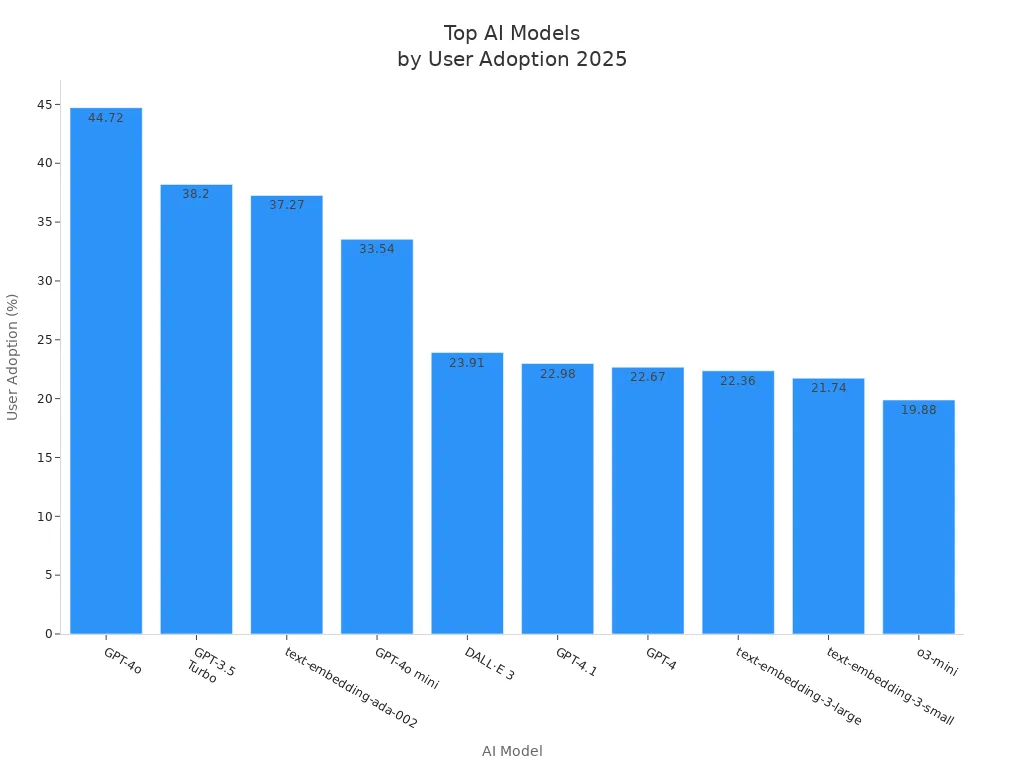
AI model rankings and analysis for 2025 show that GPT-4o holds the top spot for user adoption, followed by models like GPT-3.5 Turbo and DALL·E 3. Each model stands out in specific areas. For example, ChatGPT leads in writing, while DALL·E 3 excels in image tasks. Specialized models now outperform general ones, offering better accuracy and meeting industry needs. This focus on domain expertise helps businesses achieve better results.
Key Takeaways
GPT-4o leads in user adoption, excelling in writing tasks, while DALL·E 3 shines in image generation.
Specialized AI models outperform general ones, providing better accuracy and tailored solutions for industries like healthcare and retail.
Price-performance balance is crucial; models like Claude Sonnet 4.5 offer strong value at $0.76 per task, while GPT-5 Pro is more expensive at $7.14.
AI coding assistants boost developer productivity, allowing teams to complete 21% more tasks, but may increase review times for pull requests.
Real-time intelligence in marketing AI helps businesses adapt quickly to market changes, improving customer engagement and campaign effectiveness.
AI Model Rankings and Analysis 2025
Top Models Overview
AI model rankings and analysis for 2025 show a clear focus on both performance and cost. Experts use benchmarks like ARC-AGI tests and cost per task to compare the leading models. The table below highlights the top performers and their main attributes:
AI Model | Organization | Cost/Task | SWE-bench Score | Context Window Size | Value Proposition | Accessibility |
|---|---|---|---|---|---|---|
GPT-5 Pro | OpenAI | $7.14 | — | — | High performance | High |
Grok 4 (Thinking) | xAI | $2.17 | 75% | 256K | High cost | Limited access |
Claude Sonnet 4.5 (Thinking 32K) | Anthropic | $0.76 | 72.7% | 1M | Good value | High |
Gemini 2.5 Pro | — | 63.8% | 1M-2M | Exceptional value | High | |
Qwen 3 Coder | Alibaba | — | Moderate | 256K-1M | Ultra-low cost | High |
GPT-4.1 | OpenAI | — | 72.5% | 1M | Good value | High |
These AI model rankings and analysis reflect not only technical scores but also how accessible and valuable each model is for users.
Key Strengths and Use Cases
Each leading AI model brings unique strengths to different industries. AI model rankings and analysis consider how well these models solve real-world problems. The table below shows how top models support various sectors:
Industry | Strengths and Use Cases |
|---|---|
Healthcare | Optimizes appointment systems, enhances patient engagement, automates administrative tasks, and supports early interventions. |
Retail & E-commerce | Analyzes sales trends for inventory optimization, enhances customer engagement, automates logistics. |
Professional Services | Automates document handling, improves compliance checks, and boosts project management efficiency. |
Manufacturing | Predicts equipment issues, enhances quality control, and optimizes inventory management. |
Financial Services | Improves security through transaction analysis, streamlines loan processing, and offers predictive insights for tailored services. |
AI model rankings and analysis also highlight that models now perform well in specialized tasks. For example, GPT-4 scored in the 90th percentile on the Bar exam, showing strong legal reasoning. Some models also pass medical licensing exams, which helps in healthcare and research.
Note: Benchmarks help ensure AI systems give truthful and unbiased answers, especially in sensitive fields like healthcare. This builds trust and reduces risks when using AI in real-world settings.
Price-Performance and Market Share
Price-performance plays a big role in AI model rankings and analysis. Users want models that balance cost, speed, and accuracy. The cost per task varies widely, with Claude Sonnet 4.5 offering strong value at $0.76 per task, while GPT-5 Pro costs $7.14 per task. Grok 4 (Thinking) sits in the middle at $2.17 per task but has limited access.
Market share also depends on accessibility and value. Gemini 2.5 Pro stands out for its exceptional value and large context window, making it popular among businesses and developers. Qwen 3 Coder attracts users with its ultra-low cost and high accessibility, especially for coding tasks.
AI model rankings and analysis must also consider challenges. Many models face technical limits, such as unclear use cases or trouble integrating with older systems. Some struggle with common sense reasoning or adapting to new situations. Security risks and energy use remain concerns. Regulations and workforce readiness also affect how widely these models can be used.
By late 2025, top models show big improvements in benchmark scores, but no model is perfect.
Evaluations focus on both helpfulness and safety, which is important for choosing the right model for each job.
AI model rankings and analysis in 2025 show that the best models combine strong benchmark results, practical value, and the ability to solve real-world problems across many industries.
Writing Models Comparison
Best AI for Writing
Writers and businesses in 2025 have many choices for AI writing tools. AI model rankings and analysis show that different models excel in specific areas. The table below compares the top AI models for writing, based on user ratings and performance data:
AI Model | Rate | Best for | Pros | Cons |
|---|---|---|---|---|
GPT Models | 8.5 | General-purpose use, content creation | Natural, fluent writing; excellent for summarizing and brainstorming | Mediocre at complex coding; prone to hallucinations |
Claude Models | 8 | Deep reasoning, coding, document analysis | Strong at logic and long-form understanding | Smaller context window; higher cost |
Gemini Models | 7 | Long-context tasks, video analysis | Handles very long input well | Reasoning not noticeably better than peers |
Perplexity | 7 | Real-time web-grounded search | Fast, accurate answers with citations | Not optimized for creative writing |
Llama Models | 6.5 | Developers, startups, self-hosting | Open-source, great cost-performance ratio | Output quality variable; requires more setup |
DeepSeek | 6.5 | Reasoning-heavy tasks, math, logic | Impressive performance in math and logic benchmarks | Lags behind Claude or GPT in coding |
Grok | 7.5 | Coding, creative writing | Strong capabilities in code generation and problem-solving | May produce inaccuracies with real-time data |
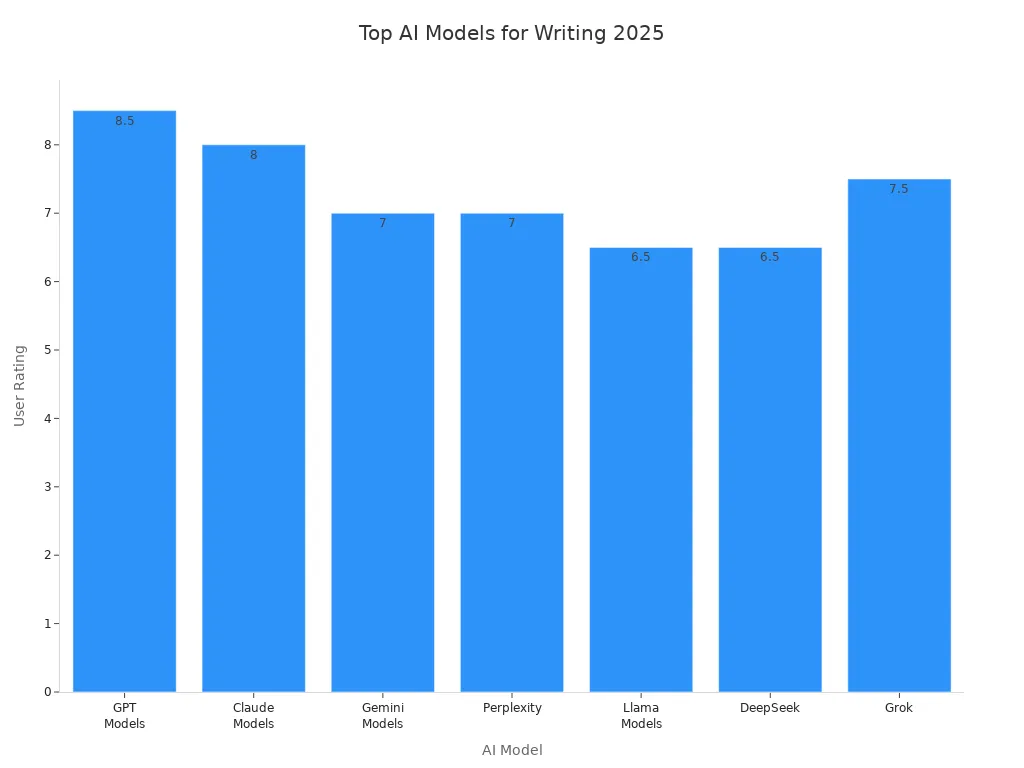
GPT models lead in general content creation and brainstorming. Claude models stand out for deep reasoning and document analysis. Gemini models handle long documents and video analysis well. Each model has strengths and weaknesses, so users should choose based on their needs.
Long-Form and Multimodal Capabilities
Long-form writing and multimodal tasks require advanced planning and flexibility. Large Context Models (LCMs) and Multimodal Large Language Models (MLLMs) bring new abilities to AI writing:
LCMs answer complex questions by finding key ideas, which leads to more insightful responses.
They help writers create outlines and expand summaries, making long-form writing easier.
LCMs plan the flow of ideas, so long articles stay clear and connected.
MLLMs use images and audio to improve text generation and translation.
These models also help with sentiment analysis and dialog by using information from different sources.
GPT-5 combines precision and creativity, making it useful for many writing and coding tasks.
Gemini Ultra processes many data types at once, which helps with cross-media projects and knowledge building.
Writers and businesses benefit from these models when they need to create detailed reports, multimedia content, or research papers. Choosing the right model depends on the task, the need for long-form planning, and the use of images or audio.
Coding AI Assistants

Top Coding Models
Developers in 2025 rely on AI coding assistants to speed up their work and solve complex problems. Surveys and benchmark results show that several models stand out. The most popular coding AI assistants include:
Replit: Known for fast code generation and easy collaboration.
Cody: Helps with debugging and code suggestions.
Cursor: Offers smart code completion and project navigation.
Gitlab Duo: Integrates with version control for team projects.
Gemini: Supports multiple programming languages and large context windows.
These models help programmers write code faster, fix errors, and learn new skills. Teams choose different assistants based on their needs and the type of projects they build.
Productivity and Integration
AI coding assistants change how developers work. They boost productivity and help teams finish more tasks. The table below compares two leading models based on real-world usage:
Model | Productivity Score | Integration Features | Use Cases |
|---|---|---|---|
Qwen 2.5 | 89.4 | Cloud & Local | Used by Xiaomi for AI assistant, gaming content |
LG EXAONE 3.0 | 9.01 (MT-Bench) | Google Cloud MLOps | Document analysis, coding solutions |
Teams using AI assistants complete about 21% more tasks. Developers create almost twice as many pull requests each day. However, review time for pull requests increases by 91% because human approval becomes a bottleneck.
AI coding assistants help individual developers work faster, but they also create new challenges for teams. Review and quality checks take longer, so companies must adjust their workflows to get the most benefit.
AI coding assistants offer strong productivity gains and flexible integration options. They fit into cloud platforms, local environments, and popular development tools. Companies use these assistants for coding, document analysis, and building AI-powered products. Choosing the right model depends on project size, team workflow, and integration needs.
Image Analysis AI

Leading Image Models
Image analysis AI models in 2025 show impressive speed and accuracy. Companies use these models to process images for healthcare, retail, and security. The table below compares the top models by processing time, quality score, and reliability rate.
Model | Average Processing Time | Quality Score | Reliability Rate |
|---|---|---|---|
FLUX.1 Dev | 1.2 seconds | 94.6% | 100% |
HiDream-I1 | 1.8 seconds | 92.1% | N/A |
SD-XL + ControlNet | 2.8 seconds | N/A | N/A |
DALL-E 3 | 3.5 seconds | N/A | N/A |
Midjourney v6 | 4.2 seconds | N/A | N/A |
FLUX.1 Dev leads with the fastest processing and highest quality score. HiDream-I1 also performs well, showing strong accuracy. SD-XL + ControlNet, DALL-E 3, and Midjourney v6 offer creative features but process images more slowly.
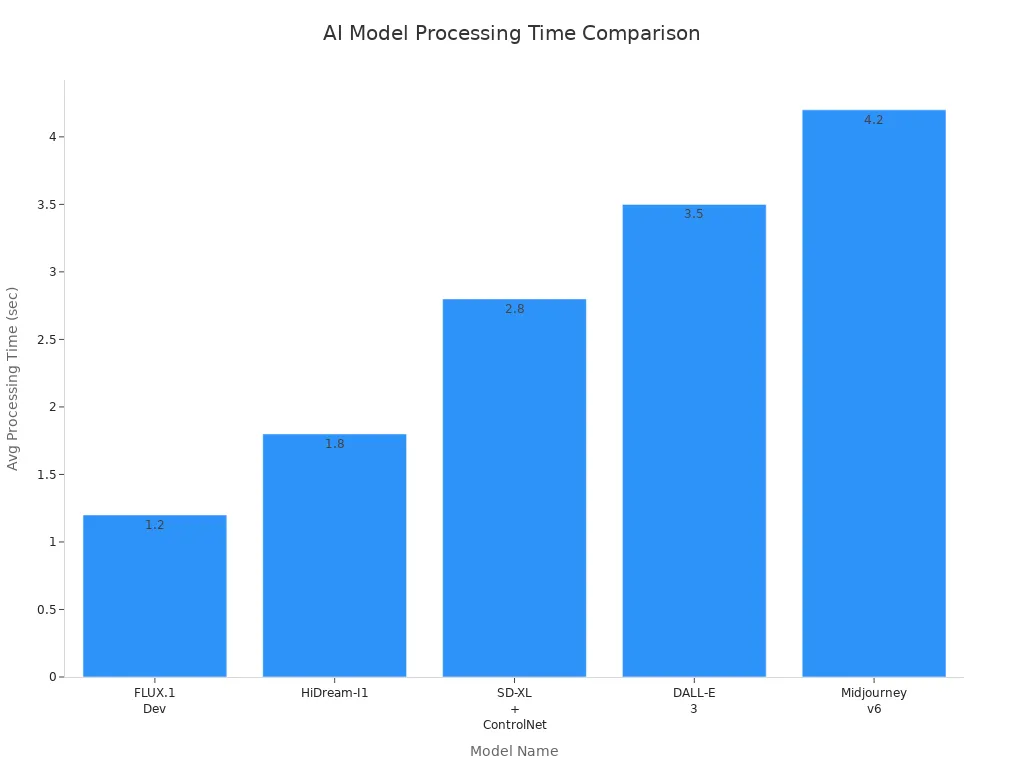
Businesses choose models based on speed, reliability, and the type of images they need to analyze. Healthcare teams use FLUX.1 Dev for quick and accurate results. Designers prefer Midjourney v6 for creative projects.
Vision-Language Fusion
Vision-language fusion changes how AI understands images and text together. Vision-language models (VLMs) combine visual skills with language reasoning. These models help users solve complex tasks.
VLMs analyze images, videos, and documents in new ways.
They identify objects and interpret X-rays, helping doctors and researchers.
VLMs answer questions about pictures and generate reports from visual data.
The M3D dataset supports vision-language fusion research. It contains 120,000 image-text pairs and 662,000 instruction-response pairs. Researchers use this dataset for eight tasks, including image-text retrieval and report generation.
The dataset improves dialogue and 3D segmentation tasks.
It helps AI models learn to connect images with language.
Vision-language fusion expands AI’s abilities in healthcare, education, and security.
Vision-language fusion makes image analysis AI smarter and more useful. Teams use these models to solve problems that need both visual and language understanding.
Video Generation AI
Best Video Models
Video generation AI models in 2025 show major improvements in realism and creative control. Leading platforms like Sora, Runway Gen-3, and Pika Labs stand out for their ability to produce high-quality videos from text prompts or images. Sora creates cinematic scenes with smooth motion and accurate lip-sync. Runway Gen-3 offers advanced editing tools and supports collaborative workflows for teams. Pika Labs focuses on avatar creation and animated storytelling, making it popular among educators and marketers.
Many users choose these models for their unique strengths. Sora delivers lifelike visuals and stable motion, which helps filmmakers and advertisers. Runway Gen-3 provides flexible editing, allowing users to change styles and add custom footage. Pika Labs supports multiple languages and offers easy avatar customization. These features help users create engaging content for social media, education, and business presentations.
Accessibility and Quality
Independent reviews compare video generation AI models using several key factors. Users look for high output quality, ease of use, and flexible customization. The following list highlights important aspects:
Output Quality: Models receive ratings for resolution, realism, motion stability, lip-sync accuracy, and scene consistency. Sora and Runway Gen-3 often score highest for cinematic quality and smooth transitions.
Ease of Use: Platforms with intuitive interfaces allow beginners to create videos quickly. Pika Labs and Runway Gen-3 offer simple workflows and helpful tutorials.
Customization & Flexibility: Users can edit scenes, add footage, change video styles, and select from multiple languages. Runway Gen-3 provides advanced editing tools, while Pika Labs excels in avatar and style options.
Features & Unique Capabilities: Sora supports cinematic video and realistic avatars. Runway Gen-3 enables collaborative editing. Pika Labs specializes in animated storytelling and language support.
Cost vs. Value: Pricing transparency and free tiers help users test features before committing. Runway Gen-3 and Pika Labs offer scalable plans for individuals and teams.
Video generation AI models in 2025 make it easier for people to create professional videos. Users benefit from high-quality output, simple interfaces, and flexible editing options. These improvements help students, teachers, marketers, and creators share ideas through video.
Marketing AI Solutions
Top Marketing Models
Marketing teams in 2025 rely on AI models to improve campaign results and reach more customers. These tools help companies create better ads, analyze data, and understand what people want. Many marketers use AI every day to plan and run campaigns. The most successful models show strong results in both return on investment (ROI) and adoption rates.
AI marketing tools increase ROI by 20% to 47%. Companies see more sales and better engagement.
AI-generated content performs well. About 56% of this content does better than content made by humans.
Most marketers trust AI. Around 88% use these tools daily to manage campaigns and create ads.
AI models help businesses save money and time. They make it easier to test new ideas and adjust strategies quickly. Teams use these solutions to target the right audience and improve customer satisfaction.
Real-Time Intelligence
Modern marketing AI models process data instantly. This real-time intelligence helps companies react to changes in the market. Fast data analysis lets businesses spot trends and adjust their campaigns before problems grow. These platforms help organizations in fast-moving industries stay ahead of competitors.
AI models map customer behavior and improve engagement. Personalized marketing strategies are now common. Consumers expect ads and messages that match their interests. AI applications play a big role in shaping these experiences.
Capability | Description |
|---|---|
Circles of Influence | Extends campaign impact by reaching trusted social networks and influencing purchase choices. |
Zeta Media Engine | Connects and activates audiences across channels, keeping data private and secure. |
Customer Understanding Toolkit | Predicts customer actions and helps marketers guide them through the buying process. |
Leading Indicators | Warns teams early about campaign health, allowing quick changes to strategy. |
Journey Insights | Shows how customers move through the sales funnel and links actions to campaign success. |
Sentiment Intelligence | Tracks public opinion in real time so marketers can adapt messages and offers. |
88% of marketers use AI to improve customer journeys.
54% of companies lower costs by using AI in their marketing.
Real-time analytics help teams fine-tune campaigns for better results.
Marketing AI solutions in 2025 give companies the tools to succeed. They help teams make smart decisions, reach more people, and create content that works.
Benchmarks vs Real-World Analysis
Benchmark Platforms
Many organizations use benchmark platforms to measure how well AI models perform. These platforms help experts compare models in a fair way. Some of the most trusted platforms in 2025 include:
Maxim AI: This platform is popular for enterprise-grade evaluation. It offers agent simulation and multi-turn testing.
OpenAI Evals: Many researchers use this open-source framework to test large language and multimodal models.
Hugging Face Evaluate: This tool connects with the Hugging Face ecosystem and provides a wide range of metrics and tasks.
EleutherAI Eval Suite: The community values this suite for its modular design and open-source innovation.
MLCommons Benchmarks: These benchmarks set industry standards and use peer-reviewed methods to measure model performance.
These platforms play a key role in AI model rankings and analysis. They help users understand which models work best for different tasks.
Practical Performance
Benchmark scores show how AI models perform in controlled tests. Real-world results can look different. Companies and users often care more about how models work in daily tasks. The table below compares top models in business and creative applications:
AI Model | Application Area | Performance Highlights |
|---|---|---|
GPT-4o | Multitasking | Maintained speed and accuracy in diverse workloads. |
Claude 3.5 | Safety-critical scenarios | Excelled but slowed under heavy loads. |
LLaMA 3.1 | Domain-specific tasks | Required tuning for peak performance, offered flexibility. |
GPT-4o scores highest for factual accuracy and nuanced reasoning.
Claude 3.5 works well in ethical and safety-sensitive settings, reducing mistakes.
LLaMA 3.1 allows users to fine-tune for specific needs, which improves accuracy.
Companies see strong results when they use AI in real-world settings. Integrating AI into customer experience and ERP systems can give a return on investment of 214% over five years. Some businesses report even higher gains. For example, Microsoft cut manual planning by half and improved on-time planning by 75%. Chobani reduced time spent on expenses by 75%. Nestlé tripled employee efficiency and removed manual expense management. SA Power Networks saved $1 million in one year and reached a 99% success rate in identifying corroding poles.
AI not only improves efficiency but also helps companies keep customers happy. Faster transactions and fewer service issues lead to higher satisfaction. Some businesses see customer churn drop by up to 55%. These results show that practical performance matters as much as benchmark scores in AI model rankings and analysis.
The leading AI models in 2025 show clear strengths in each domain. The table below highlights which models excel and why:
Domain | Leading AI Model | Key Strengths |
|---|---|---|
Writing | OpenAI o1 | Strong in writing, code debugging, and advanced reasoning. |
Coding | Mistral Medium 3 | Excels at coding and STEM tasks, follows instructions well. |
Image | Llama 4 Maverick | Great for image and text understanding, ideal for marketing visuals. |
Video | GPT-4o | Handles video data, generates images, and summarizes content effectively. |
Marketing | Llama 4 Maverick | Produces videos and images, supports marketing campaigns with multimodal skills. |
For different users, the best approach varies:
Businesses should use AI-driven recommendation systems for search products.
Companies benefit from human experts when recommending experience products.
Marketers can improve campaigns by matching AI strengths to their goals.
Matching the right AI model to each task ensures better results. Real-world performance matters more than test scores. The AI landscape changes quickly. The table below shows trends to watch:
Trend | Description |
|---|---|
Rise of AI Agents | AI agents attract investors and drive mergers and acquisitions. |
Market Consolidation | Many AI startups merged or were acquired in Q3’25. |
Private AI companies raised over $45 billion despite fewer deals. | |
Generative Engine Optimization (GEO) | GEO tools help brands stand out in AI search platforms. |
Talent Premium | AI companies reach high valuations, showing strong demand for skilled workers. |
Readers should stay informed as new models and trends appear. Choosing the right AI tool helps every team succeed.
FAQ
What makes an AI model "top-ranked" in 2025?
Experts look at benchmark scores, real-world performance, and user adoption. Models that solve tasks quickly and accurately earn higher rankings. Accessibility and cost also play important roles.
How do businesses choose the right AI model?
Businesses compare models based on their needs. They check price, speed, and reliability. Many use tables to match model strengths with tasks. Teams often test models before making a final choice.
Are specialized AI models better than general ones?
Specialized models perform better in specific areas like coding or image analysis. General models handle many tasks but may not reach the same level of accuracy. Companies often pick specialized models for important jobs.
What is a context window in AI models?
A context window shows how much information a model can process at one time. Larger context windows help with long documents or complex tasks. Models with bigger windows often give better results.
Do benchmark scores always match real-world results?
Benchmark scores show how models work in tests. Real-world results can differ. Users should check both scores and practical outcomes before choosing a model.
See Also
Best 10 AI Tools for Creating TikTok Videos in 2025
McKinsey Released Its Comprehensive AI Report for 2025
The Complete Collection of AI Tools for Sales

© Copyright 2025 LinkstartAI - All Rights Reserved.