McKinsey just dropped its 2025 AI report.

AI adoption in organizations continues to accelerate in 2025. Many companies explore new tools and applications, but most remain in pilot or early phases.
Nearly two-thirds of organizations have not started scaling AI across the enterprise, while only about one-third report progress in scaling their AI programs.
Employees show strong engagement: 75% of knowledge workers use AI daily, and 78% introduce personal AI tools into workflows.
Despite this enthusiasm, most organizations see little enterprise-wide financial impact. Over 80% report no meaningful effect on EBIT, highlighting a persistent gap between experimentation and true transformation.
Key Takeaways
AI adoption is widespread, but most organizations are still in early stages. Two-thirds have not scaled AI across their operations.
Employees are highly engaged with AI tools, with 75% using them daily. However, many organizations see little financial impact from these tools.
Leadership plays a crucial role in AI success. Companies that treat AI as a core part of their strategy achieve better results.
High-performing organizations focus on building a culture of innovation and reskilling employees to work alongside AI systems.
Addressing barriers like data quality and talent shortages early can help organizations maximize the benefits of AI.
AI Adoption in Organizations: 2025 Overview

Widespread Use, Limited Scaling
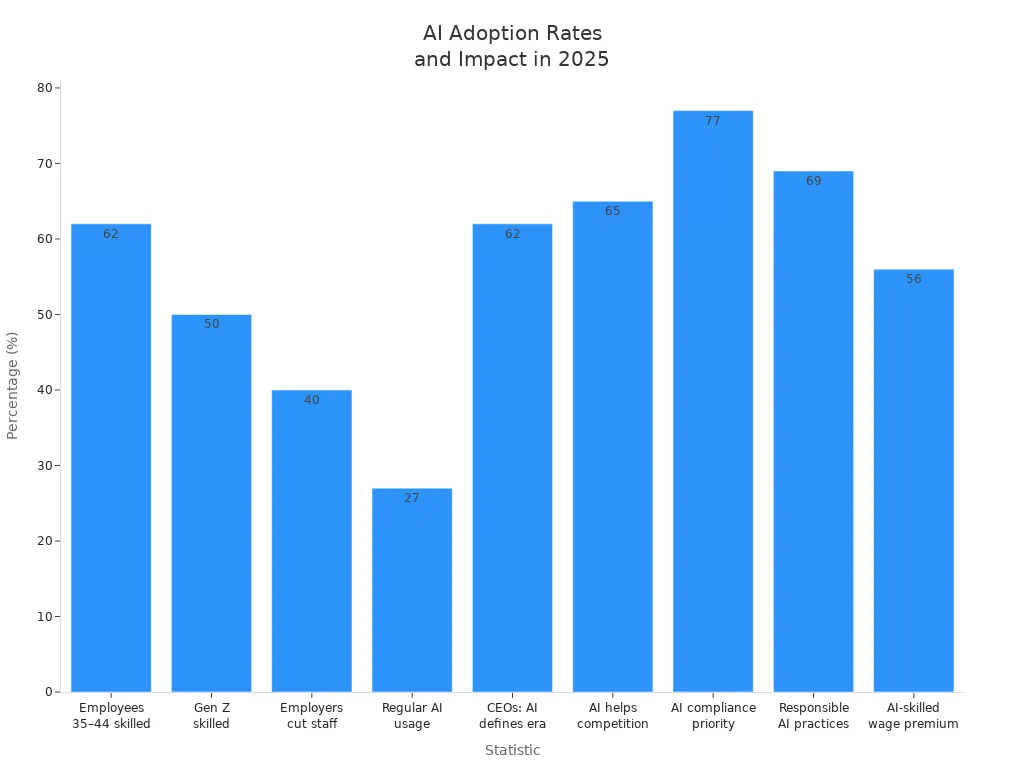
AI adoption in organizations has reached new heights in 2025. Many employees now use AI tools daily, and companies report strong engagement across age groups. For example, 62% of employees aged 35–44 are highly skilled with AI, while 50% of Gen Z workers also show advanced skills. Regular AI usage among white-collar employees has grown to 27%, up from 15% in 2024. Despite this widespread use, most organizations remain in the early stages of scaling. Two-thirds of hospitals and many other businesses are still piloting or exploring AI strategies. Only a small fraction have managed to scale AI solutions across the enterprise.
Note: CEOs recognize the importance of AI, with 62% believing it will define the next business era. However, only about one-third of organizations report progress in scaling their AI programs.
A closer look at workforce trends reveals that AI adoption in organizations brings both opportunities and challenges. Employers plan to cut staff due to automation, with 40% considering reductions. At the same time, employees skilled in AI see wage growth twice as fast and revenue growth three times faster than their peers. The skills evolution rate for AI-skilled workers is 66% faster, and these workers enjoy a 56% wage premium.
Statistic | Value |
|---|---|
Percentage of employees aged 35–44 highly skilled with AI | 62% |
Percentage of Gen Z workers (18–24) highly skilled with AI | 50% |
Potential workforce replacement due to AI adoption | 6–7% of the US workforce |
Employers planning to cut staff due to AI automation | 40% |
Revenue growth for employees using AI | 3 times faster |
Wage growth for employees using AI | 2 times faster |
Skills evolution rate for AI-skilled workers | 66% faster |
Wage premium for AI-skilled workers | 56% |
Regular AI usage among white-collar employees | 27% (up from 15% in 2024) |
CEOs believing AI will define the next business era | 62% |
Organizations reporting AI helps them stay ahead of competition | 65% |
Companies prioritizing AI compliance | 77% |
Organizations adopting responsible AI practices | 69% |
Top challenges for AI adoption | Data accuracy/bias (45%) |
Lack of proprietary data (42%) | |
Insufficient generative AI expertise (42%) | |
Weak financial justification (42%) | |
Privacy/data confidentiality concerns (40%) |
Industry and Function Trends
AI adoption in organizations varies by industry and business function. Financial services, manufacturing, and retail lead the way. The financial sector could gain up to $1.2 trillion in extra value by 2035 through AI. Manufacturing stands to add $3.8 trillion, thanks to robotics and IoT. Retailers have already seen a 15% increase in conversion rates during major sales events by using AI-powered chatbots. Healthcare lags behind, mainly due to the complexity and responsibility of medical applications.
Industry | Adoption Status | Evidence |
|---|---|---|
Financial Services | Leading | The financial sector can gain up to $1.2 trillion extra GVA due to AI adoption by 2035. |
Manufacturing | Leading | AI could add an extra $3.8 trillion GVA in manufacturing by 2035, aided by robotics and IoT. |
Retail | Leading | Retailers experienced 15% higher conversion rates using chatbots during Black Friday. |
Healthcare | Lagging | Healthcare is slower in AI adoption due to the complexity and responsibility of medical applications. |
The adoption rate also differs by business function. Marketing and PR departments lead, with 92% of companies using generative AI for these tasks. In Tech & Telecom, over 80% of businesses use AI, either fully or selectively. Finance, HR, and construction also show high adoption rates, with 77%, 72%, and 74% respectively.
Tip: Organizations in healthcare are projected to see a compound annual growth rate of 36.83% in AI applications, especially in diagnostics and patient management. Manufacturing follows with a 32.06% growth rate, focusing on predictive maintenance and supply chain optimization.
Rise of AI Agents
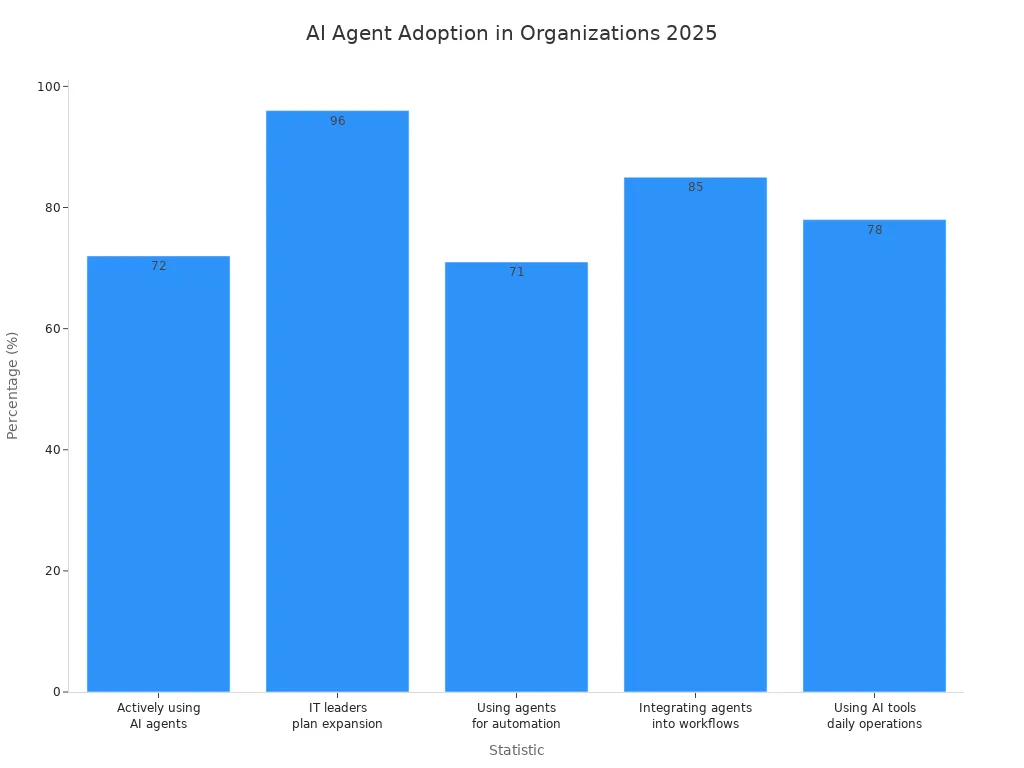
Agentic AI systems have become a major trend in 2025. These AI agents automate tasks, manage workflows, and support decision-making. About 72% of organizations now use AI agents, and 85% have integrated them into their workflows. Enterprise IT leaders show strong interest, with 96% planning to expand the use of AI agents. Intelligent agents are most often used for process automation, with 71% of organizations deploying them for this purpose.
Experimentation with agentic AI systems is common, especially as organizations look to scale their capabilities. The number of organizations deploying AI agents has jumped from 11% to 33%. This shift signals a move from experimentation to deeper integration into business infrastructure. Most experimentation occurs in areas where automation and workflow improvements can deliver quick wins, such as customer service, operations, and IT support.
Organizations that lead in AI adoption in organizations often focus on integrating AI agents into critical business functions, setting the stage for future enterprise-wide scaling.
Scaling AI: Progress and Barriers
What Scaling Means in 2025
Scaling AI in 2025 means more than deploying a few pilot projects. Leading organizations now treat AI as a core part of business transformation. They move beyond isolated experiments and focus on integrating AI into daily operations and decision-making. Leadership plays a key role in this shift. Executives set the vision, allocate resources, and create a culture that supports AI at scale.
The following table shows how executive involvement in generative AI initiatives has changed:
Year | Percentage of Executives Advancing Gen AI Initiatives |
|---|---|
2024 | 16% |
2025 | 89% |
Organizations now see AI as a driver of long-term value. They build strong foundations for strategic scaling. This approach ensures that AI becomes part of the core business strategy, not just a technology project. Leadership involvement helps create the right environment for scaling. Teams receive support, training, and clear goals.
Note: AI adoption in organizations now requires a shift in mindset. Companies must view AI as a transformation journey, not just an IT upgrade.
Barriers to Enterprise Adoption
Many organizations face significant barriers when trying to scale AI. These challenges can slow progress and limit the impact of AI on business outcomes.
Data Quality and Bias: Poor or biased data leads to unreliable results. Trust in AI systems drops when outputs are inconsistent.
Insufficient Proprietary Data: Many companies struggle to gather enough high-quality data. Data often remains siloed or fragmented.
AI Talent Shortage: There is a lack of skilled professionals who can design, deploy, and maintain AI systems.
Unclear ROI and Business Case: Proving the financial value of AI projects remains difficult. Stakeholders hesitate to invest without clear returns.
Privacy, Security, and Compliance: New regulations require companies to protect sensitive data and follow strict rules.
Integration with Legacy Systems: Outdated technology makes it hard to connect AI tools with existing workflows.
Organizational Resistance: Employees may fear change or resist adopting new AI-driven processes.
Regulatory and ethical concerns also shape the scaling process. Governments introduce new guidelines to ensure responsible AI development. Businesses must comply with frameworks like the EU AI Act. This means adopting audits, data protocols, and monitoring tools. Companies need to align technology with privacy, security, and ethical standards. Regional regulations continue to evolve, so organizations must stay agile.
Evidence Description | Key Points |
|---|---|
Governments enforce responsible AI development and deployment. | |
AI governance surge | Businesses must comply with ethical and transparent AI practices. |
Implementation of new processes | Companies adopt audits, data protocols, and monitoring tools. |
Alignment of tech and regulation | Focus on privacy, security, and ethical usage through new policies. |
Regional regulatory frameworks | Organizations must adapt to new regulations as they emerge globally. |
Tip: Addressing these barriers early helps organizations avoid costly delays and build trust in AI systems.
Lessons from High Performers
High-performing organizations offer valuable lessons for scaling AI. Only 26% of companies have realized the full value of AI. Leadership stands out as the main factor that separates high performers from others. Successful companies assess their readiness before deploying new tools. They encourage a bottom-up culture where employees feel empowered to innovate and adopt AI.
Some leading companies, such as Walmart and JPMorgan Chase, use AI to optimize supply chains and analyze contracts. These organizations implement clear governance and orchestration to manage workflows. Human oversight remains important. Teams monitor AI outputs to catch errors and add human judgment.
Key strategies from high performers include:
Assessing institutional readiness before launching AI projects.
Building a culture that supports innovation and adoption from the ground up.
Ensuring human oversight to add nuance and catch mistakes.
Implementing clear governance to manage AI workflows.
Advancing generative AI initiatives with strong executive support.
Note: About 89% of executives now advance generative AI initiatives. However, 50% of employees use unauthorized AI tools, which can create risks. High performers address these risks with strong policies and training.
Organizations that follow these lessons move faster and achieve better results. They turn AI adoption in organizations into a source of competitive advantage.
Financial and Innovation Impact
Value from AI Adoption in Organizations
Organizations in 2025 see mixed financial results from AI adoption. Many treat AI as a measured investment, achieving return on investment (ROI) rates of 55% on advanced initiatives. Some sectors, such as Legal and CPA, report an estimated annual impact of $32 billion. The average value per person reaches $19,000. However, 42% of companies abandoned most of their AI projects due to unclear value.
Sector | Estimated Annual Impact |
|---|---|
Legal & CPA | $32B |
Average Value | $19,000 per person |
Companies measure ROI in several ways:
Measurable ROI: Direct impacts like cost savings and revenue increases.
Strategic ROI: Progress toward long-term goals, such as digital transformation.
Capability ROI: Growth in AI maturity, skills, and readiness.
For example, a retail chain using AI-driven inventory management tracks cost savings, operational efficiency, and workforce skill improvements.
Innovation and Customer Experience
AI adoption in organizations drives innovation, but the impact on workforce numbers remains limited. The U.S. Census Bureau’s 2023 Annual Business Survey shows most businesses did not change their number of workers after adopting AI. Skill levels also stayed the same, challenging expectations about innovation.
AI improves customer experience by helping companies understand customer needs and personalize interactions. Organizations now use both experiential and operational metrics to measure success:
Experiential metrics, such as Customer Effort Score and Net Promoter Score, focus on customer feelings and loyalty.
Operational metrics, like First Contact Resolution and Containment Rate, measure efficiency and profitability.
New metrics emphasize emotional impact and ease of resolution, reflecting changing customer expectations.
Financial Gains of High Performers
High-performing organizations stand out by using AI-driven personalization strategies. These companies report average increases in consumer spending of 38%. They achieve measurable financial gains by integrating AI into core business functions and tracking results. Most high performers treat AI as a strategic investment, supporting both innovation and profitability.
Companies that prioritize AI maturity and workforce readiness see greater financial and innovation outcomes.
Workforce Implications
Workforce Size Expectations
Organizations in 2025 see mixed outcomes for workforce size as AI adoption grows. Some companies expect to reduce headcount by automating repetitive tasks. Others plan to maintain or even increase staff, especially in roles that require advanced skills. Many leaders focus on reskilling and upskilling employees to adapt to new technologies. They recognize that AI changes job requirements rather than simply replacing workers. Companies now value employees who can work alongside AI systems and use them to improve productivity.
AI-Driven Hiring Trends
AI is transforming how organizations approach hiring. Many companies use AI to automate repetitive recruiting tasks, such as writing job descriptions and screening resumes. This shift allows HR professionals to spend more time on activities that require human judgment, like interviewing and assessing cultural fit. Organizations emphasize the importance of keeping the human element in hiring decisions. They encourage HR teams to develop new skills for interpreting AI-driven insights and balancing efficiency with empathy.
AI tools help automate resume screening and job description writing.
HR professionals focus on interviews and evaluating soft skills.
Training on ethical AI use becomes standard for hiring teams.
Upskilling HR staff ensures they can manage AI tools responsibly.
Companies also see a rise in demand for workers with AI skills. In 2024, nearly 628,000 job postings required at least one AI skill. The percentage of jobs needing AI expertise continues to grow, especially in computer and mathematical fields. Employers also seek candidates with strong communication, leadership, and critical thinking abilities.
Workflow and Organizational Change
AI integration leads to significant changes in workflows and organizational structures. Many organizations create ethics review boards to oversee AI applications. They introduce training programs to build a shared understanding of ethical principles. Regular audits of AI systems become common to ensure compliance with guidelines. New job categories, such as AI trainers and ethics officers, emerge to manage and monitor AI systems. These changes help organizations use AI responsibly and adapt to a rapidly evolving business environment.
AI Risk Management Strategies

Common AI Risks in 2025
Organizations in 2025 face a growing set of risks as they adopt AI technologies. These risks can threaten data security, privacy, and business operations. The most common AI-related risks include:
Data Poisoning: Attackers insert false data into training sets, which can corrupt AI models.
Model Inversion: Hackers extract sensitive training data by querying AI systems.
Adversarial Examples: Small changes to input data can cause AI to make mistakes.
Model Stealing: Competitors or attackers replicate proprietary AI models through repeated queries.
Privacy Leakage: AI models may reveal confidential information from their training data.
Backdoor Attacks: Malicious actors embed hidden triggers in AI models, leading to unexpected behavior.
Evasion Attacks: Manipulated inputs can bypass AI detection systems.
Organizations must recognize these risks early to protect their data, reputation, and customers.
Mitigating AI-Related Risks
Companies use a range of strategies to manage AI risks and build trust in their systems. The most effective approaches include:
Implementing AI Risk Management Frameworks: Many organizations align with standards like NIST’s AI Risk Management Framework or MITRE ATLAS.
Maintaining an AI Bill of Materials (AIBOM): Teams document all AI supply chain dependencies for greater transparency.
Using Model Registries: Companies track AI model versions and monitor their lifecycle for better control.
Incremental AI Implementation: Leaders start with non-critical systems before expanding AI use.
Adopting Enterprise AI Policies: Centralized governance boards oversee AI deployment and compliance.
Developing AI Incident Response Plans: Organizations prepare for breaches to ensure quick action.
These steps help organizations reduce vulnerabilities and respond quickly to incidents.
High Performer Approaches
High-performing organizations take a proactive approach to AI risk management. They integrate AI into their risk assessment processes and use real-time data analysis to spot threats early. These leaders stay updated on changing regulations and build strong governance frameworks to oversee AI systems. For example, 76% of executives in financial services use AI for fraud detection, while 68% focus on compliance and risk management.
Recent incidents, such as Samsung’s data leak and Air Canada’s chatbot case, show the importance of oversight and legal awareness when using AI tools.
High performers set the standard by making risk management a core part of their AI strategy. They protect their business and build trust with customers and regulators.
What Sets High Performers Apart
Leadership and Investment
High-performing organizations lead with strong vision and commitment. Leaders treat AI adoption as a full organizational transformation. They do not just buy new tools. Instead, they invest in systems that support AI across the business. Clear policies guide teams and prevent risky or careless use of AI. These companies build strong data infrastructure. They know that good data helps AI work better. Teams use version control and safety nets to manage AI-generated code. Quick rollbacks keep systems safe. Before scaling AI, leaders map value streams. This step helps them see how AI will impact the whole company, not just one part. User focus stays at the center. Teams design AI to help people do their jobs better.
Leadership and Investment Practices | Description |
|---|---|
Treat AI adoption as an organizational transformation | Focus on investing in foundational systems that enhance AI benefits rather than just purchasing tools. |
Establish clear AI policies | Clear guidelines prevent underutilization and risky overuse, fostering a safe environment for experimentation. |
Invest in data infrastructure | Quality and integration of data are crucial for maximizing AI's impact, requiring tailored solutions beyond generic models. |
Strengthen version control and safety nets | Robust practices are necessary for managing AI-generated code effectively, allowing quick rollbacks when needed. |
Map value streams before scaling AI | Understanding systems-level impacts prevents localized optimizations that do not enhance overall performance. |
Maintain user focus | A user-centric approach ensures that AI development aligns with team performance and goals. |
Ambitious Goals and Workflow Redesign
High performers set bold goals for AI. They build a culture where teams feel safe to test new ideas and learn from mistakes. Leaders encourage everyone to try new things and adapt quickly. Success comes from how teams design their work, not just from technology. These organizations redesign roles and workflows to fit AI. They want people and AI to work together smoothly. Teams focus on innovation and smart ways to solve problems.
Teams feel responsible for results and are open to trying new approaches.
Leaders create spaces for testing and learning.
Work design matters more than just having the latest technology.
Roles and workflows change to fit AI, not the other way around.
Teams value intelligent innovation and keep improving.
Robust Management Practices
Strong management sets high performers apart. These organizations embed AI into daily workflows. They do not add AI as an afterthought. Teams use AI insights to make better decisions and improve how work gets done. Leaders make sure that AI connects directly to systems that carry out tasks. This approach boosts efficiency and helps teams reach their goals faster. High performers keep reviewing and updating their management practices to stay ahead.
AI becomes part of everyday work, not just a special project.
Insights from AI guide real actions and decisions.
Teams update processes often to keep up with changes.
Leaders focus on making AI useful for everyone in the company.
High-performing organizations show that strong leadership, bold goals, and smart management help AI deliver real value.
Most organizations remain early in their AI journey. High performers show clear paths to value through strong leadership, targeted investment, and workflow redesign. To scale AI and maximize impact, leaders should:
Set ambitious goals and invest in data infrastructure.
Redesign workflows for AI integration.
Build robust risk management practices.
Leaders can assess their organization’s AI maturity and use lessons from high performers to guide next steps.
FAQ
What is the biggest challenge organizations face with AI adoption in 2025?
Many organizations struggle with data quality and a shortage of skilled workers. Leaders also find it hard to prove the value of AI projects. These challenges slow down progress and limit results.
How do high-performing companies manage AI risks?
High performers use strong governance, regular audits, and real-time monitoring. They follow industry standards and train teams to spot problems early. This approach helps protect data and build trust.
Will AI replace most jobs in the next few years?
AI changes many jobs but does not replace most workers. Companies often reskill employees and create new roles. Most organizations expect workforce size to stay the same or grow.
Which industries benefit most from AI in 2025?
Financial services, manufacturing, and retail see the biggest gains. These sectors use AI for automation, better customer service, and smarter decision-making. Healthcare adoption grows but faces more challenges.
See Also
The Comprehensive Toolkit for AI-Driven Sales Success
A Deep Dive Into AI Agents and Their Functionality
Jule: The AI Assistant Simplifying Software Development Tasks

© Copyright 2025 LinkstartAI - All Rights Reserved.